Kennedy Space Center, Florida – SpaceX successfully launched an Inmarsat communications satellite into orbit yesterday evening, May 15. Inmarsat-5 F4 joins three other Global Xpress (GX) satellites already in orbit, while SpaceX continues to operate at a near-term pace of a launch every two weeks. The industry may run out of satellites before SpaceX runs out of capacity, but let’s hold that thought…
The launch of Inmarsat-5 F4 took place at 7:21 p.m. ET from Launch Complex 39-A at NASA’s Kennedy Space Center by a Falcon 9 vehicle. Due to the weight of the satellite, over 6,000 kilograms, the Falcon 9 used all of its fuel to successfully put the satellite into orbit, expending the first stage instead of flying it back for a landing and reuse on another flight.
Inmarsat F4 has a whopping 89 fixed Ka-Band beams to deliver service, plus another six steerable spot beams capable of adding additional capacity to specific areas or region. Over the next couple of weeks, F4 will use a combination of chemical and electric propulsion to level out its current orbit and move it into geostationary position for production service above a fixed region of the world.
The Global Xpress (GX) broadband service can deliver up to 60 Mbps to a 60 centimeter fixed dish, as well as deliver service – albeit at lower speeds – to moving vehicles, including ships and aircraft. With three satellites in operation and a fourth moving into a production orbit, Inmarsat is able to prove truly seamless global service. If you are on a long-distance flight over an ocean with Air New Zealand, Lufthansa, Austrian Airlines, or Singapore Airlines, GX provides the in-flight Internet connectivity.
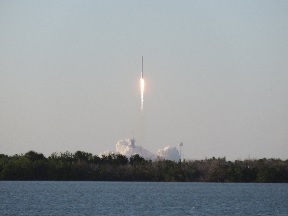 Image via Doug Mohney
Inmarsat is still looking at options on where and how it will deploy the F4 satellite, but officials noted India would be an interesting market. The satellite could also be moved around as needed to either supplement existing service or replace another one in case of a premature failure. Clearly, executives believe F4, originally built as a ground spare in case of an accident, is better off in orbit to produce billable revenue – a philosophy other satellite operators may adopt in the future. Keeping a spare satellite on the ground isn’t cheap, requiring specialized environmental storage to keep it in launch-worthy condition.
SpaceX has conducted two launches over the 30 days and will be conducting two more launches in the next 30 days. On June 1, SpaceX will conduct a supply launch to the International Space Station for NASA, while on June 15 the second launch of a “flight-proven”/used Falcon 9 first stage will take place to put a Bulgarian communications satellite into orbit.
Beyond June 15, there are another four flights booked through the end of July, putting the company on pace to do anywhere between 18 to 24 launches by the end of the year, including at least six first stage re-use flights. This will clear out SpaceX’s current backlog of launches it has built up, leaving it with a fleet of flight-proven first stages and a factory in full swing cranking out hardware.
SpaceX could conceivably find itself with more flight hardware than satellites in a few years, given the long lead time of two to three years it currently takes aerospace companies to build and test large communications satellites. Since Europe, Japan, China, and Russia will all want to continue to launch their own satellites to preserve their spaceflight capabilities, this means SpaceX will likely have excess capacity to launch its own broadband satellites in a few years, assuming the company continues on its path of reliability and reuse.
Edited by
Alicia Young