As expected, the iPad Mini has arrived. Unexpectedly, Apple also threw its seven month old iPad under the bus to roll out a new fourth generation product. Combined with a lot of trash talk about the Google Nexus, it is clear that Apple is -- shall we say -- concerned about the tablet market in a big way.
The third generation iPad was introduced on March 7, 2012. Featuring a dual-core A5X processor with quad-core graphics and the oh-so-cool Retina Display first introduced on the iPhone 4, analysts expected the March (Spring fashion?) iPad to be good for about a year before it would get an upgrade.
At the same price as the Spring model, the fall iPad uses Apple's own A6X processor, 10 hours of battery life, FaceTime HD and upgraded cameras, expanded LTE support, and Apple's still-new and proprietary Lightning port. Apple says the A6X has twice the performance of the A5X and it makes sense to upgrade the (frankly lame) cameras over earlier models and add Lightning, but to do it so soon means the company feels it doesn't have to worry about taking a big hit from anyone who bought the Spring model.
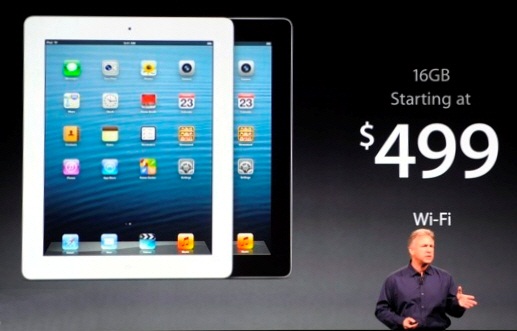
It also makes sense to roll out Lightning-using devices as quickly as possible in order to flush out all the old 30 pin connector technology out of the existing product line, but that's another "We're going to annoy our existing customer base" moment given the number of people who own both iPhones and iPads and will end up having to trash all of their old cables and supporting iThing devices built around old connectors.
If Apple had simply said "We decided to bite the bullet and move the mainstream iPad to newer technology faster," the media and existing customers probably would have nodded and just moved on.
But the company said nothing. Instead, Apple SVP of Marketing Phil Schiller spent a lot of stage time trashing the Google Nexus 7 as he compared it to the iPad Mini. It's a tactic that doesn't sit well with me, given its use in the 2012 Presidential race. If you are spending more time talking about how the other guy's product is flawed by using a bunch of subjective criteria rather than promoting the high points of your new product, it suggests that you (Apple) are concerned that the Google Nexus 7 and other tablets may be actually gaining ground.
Apple's bigger problem might simply be on price. Trying to get people to buy up to a $329 iPad Mini when there's a $200 Google Nexus 7 on the table might be a bit difficult, and that's before you add in a Lightning "tax" for non-standard cables and devices. There are a lot of different offerings in the "7 and under/under $300" Android tablet space and the market should be very competitive as existing hardware manufacturers try to outdo each other on price, performance, and features.
I'd also argue that having a mini-sized tablet price tag in the $200 range is an easier consumer buy decision. Once you start getting closer to $400 dollars, people will looking at paying a bit more to move to a device with a larger screen size and the ability to do more than simply be a basic light-web/entertainment device. When that decision-making process starts, it brings in larger Android tablets, the (Fall) Apple iPad, and Microsoft Surface RT -- diverting attention from both the iPad mini and the iPad.
Edited by
Brooke Neuman
