Every once and awhile as a sanity check I go to the keeper of the numbers to try and validate not just my own opinions, but those of the infamous “industry observers.” Truth be known, despite the apparent contradictory evidence in political discourse around the world, facts still matter. That is why I checked in with my favorite source on search engine activities, Reston, VA-based comScore. There is an old saying here in the U.S. that, “You can’t tell the players without a score card,” and fortunately comScore, as its name implies, knows how to keep score.
What sent me through my bookmarks was a question asked by a colleague about how fortress Google was holding up given the desire of “E”veryone to put a dent in their ecosystem by somehow/some way challenging Google’s domination of search. They were interested in the U.S. standings because of the criticality of the American market on a variety of fronts.
No surprises
Without further ado, here are the results from comSocre’s monthly
comScore qSearch analysis of the U.S. search engine market starting with market share.
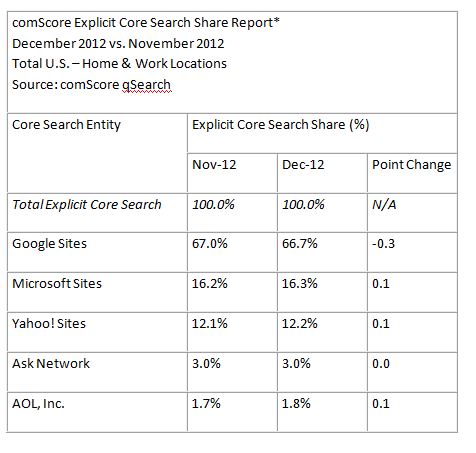
*“Explicit Core Search” excludes contextually driven searches that do not reflect specific user intent to interact with the search results.
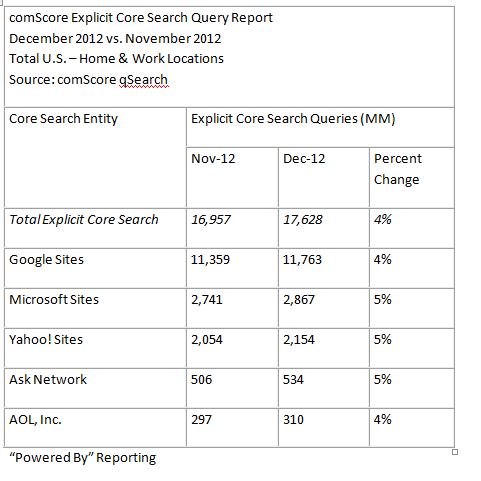
The raw numbers, other than demonstrating the unbelievable amount of searching that goes on, show a remarkably similar story in terms of not just share, but in the percent increase in traffic month over month. This is an increase that is likely seasonal given the holidays and the increase in online shopping that just occurred.
Unlike the browser wars where the supposed unassailable position of Internet Explorer has been successfully assailed by Chrome – or for that matter, the Android device market, which has seen Samsung distancing itself from the rest of the field in a market that one would have thought was a commodity – SEARCH is different.
And while this is just a one month snap shot, if you were to go back through the comScore historical data, you will see why industry observers like to believe that Google really is different, i.e., will be hard to displace and causes major nightmares for other competing ecosystems including Apple and especially Microsoft.
In this case, a picture may not be worth a thousand words, but two pictures are certainly worth several hundred as a sanity check. Let’s just say that the occasional glance at these numbers maybe one of the best indicators for understanding all aspects of ecosystem search and destroy missions.