Wallops Island, Virginia – A decade or so ago, laser communication was one of the tools of the trade for establishing high-speed broadband connections between two points before fiber became plentiful. Now NASA has two projects in the works to demonstrate optical links across tens and hundreds of thousands of miles for satellite use, bringing a totally new meaning to “free space” communications.
NASA’s first demonstration will take place in a few weeks, as the LADEE satellite circles around the Moon. Onboard the 393 kilogram satellite is the Lunar Laser Communications Demonstration (LLCD). As LADEE settles in, LLCD will use a near-infrared laser to pump data downstream at speeds up to 622 Mbps, with an uplink speed around 20 Mbps.
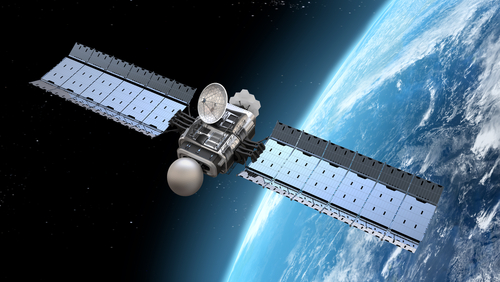
Image via Shutterstock
LLCD is a 65 pound system made up of an optical module, a modem module and a controller electronics module. A 10 centimeter wide telescope onboard the satellite will point a 0.5-watt infrared laser – the same type used in ground-based fiber optic cables -- at one of three receiving stations on earth, where the now 5 kilometer wide beam (yes, it’s a LOT of spread) will be picked up by a cluster of four 17 inch telescopes used to collect and focus the signals into optical fiber and detectors. A cluster of four 6 inch telescopes are used to send a beacon to the satellite for pointing, as well as uplink data.
Two reception sites are located in the United States with a third in Europe - White Sands, New Mexico, JPL’s Optical Communications Telescope Lab in Wrightwood, California, and the European Space Agency’s Optical Ground Station in Tenrite, Spain. A six month study of sites around the world was conducted to find the right balance of clear skies – clouds/fog/rain and lasers don’t mix – and access to high-speed ground broadband. Researchers didn’t want to pull 622 Mbps down only to bottleneck into 45 Mbps speeds on the ground.
A spokesperson working on LLCD said the 622 Mbps downlink speed is a significant increase over the roughly 100 Mbps Ka-band systems used on a previous lunar mission. A NASA glossy says that while an HD movie downloaded at current radio transmission rates would take over 60 minutes, LLCD would be able to down load a same-length video in under eight.
NASA’s next laser communications demonstration project will be closer to home and go faster. The Laser Communications Relay Demonstration (LCRD) is expected to be launched as a hosted payload onboard a Space Systems/Loral communications satellite in 2017. LRCD will operate for two years, using a pair of optical terminals in geosynchronous orbit to transmit at speeds up to 1.25 Gbps in both directions.
Successfully demonstrations of optical communications will allow NASA to put bandwidth-intensive instruments, such as hyperspectral images and SAR radar, on planetary probes. It will also open up optical communications to be used for data in satellites closer to earth, allowing designers to pack more bandwidth into a smaller, more power-efficient footprint.
Edited by
Blaise McNamee