It's the kind of thing that most anyone can fall prey to: the “just one more” phenomenon that comes with most of our electronics. Just one more game, just one more video, just one more chapter in that new e-book; all of these things combine to give us just a little more screen time just before bed, about the only time in the day many have for such things. But a new study has augmented the idea that screen time just before bed is a great way to leave the user not only sleep deprived, but also less likely to perform well at work the next day.
The study in question, which appeared in, “Organizational Behavior and Human Decision Processes,” was conducted in two parts. Under the first part, several surveys were taken by 82 upper-level managers, which offered a variety of questions on things like smartphone use for work, as well as how well and for how long said users slept. The surveys were given out at various times of day, including one survey at six in the morning, followed up by another at four in the afternoon. The second part of the study turned to 161 employees in a host of fields ranging from accounting to dentistry, and included not just smartphones, but also other screens like laptops and televisions.
The results of the study found that using a smartphone after nine in the evening led to both decreased overall sleep quantity, and decreased engagement the next day at work. This point was found in both parts of the study, between the employees and the managers, so it became somewhat clear that the common issue here was smartphones. Interestingly, those who turned to tablets, laptops, and television just before bed didn't have similar problems; the smartphone was the biggest issue of getting enough sleep in each case.
The issue, according to Michigan State University's Russell Johnson, is that smartphones, “...keep us mentally engaged late into the evening.” This point, in turn, makes it difficult to break off from work and relax, allowing sleep to follow in its natural course.
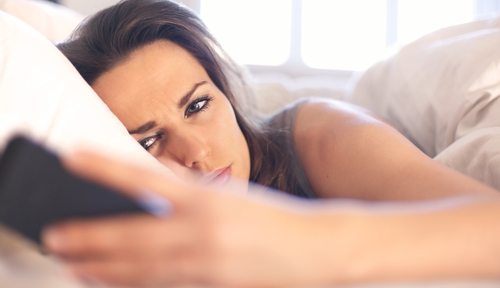
Image via Shutterstock.
So the simple solution here seems to be to leave the smartphone alone about an hour or so before going to sleep. Users who follow such a practice are likely to get more sleep, and better quality sleep, than those who don't shut down for the night and stay shut down. At the very least, users who look into letting a laptop take over for the smartphone, or just watching a little television instead before bed are likely to do better. That's not always easy to do, nor is it—for many users—even always possible. Things like the bring your own device (BYOD) doctrine have allowed users to get a lot more flexible in terms of work, and that includes working late at night. Such practices may do more harm than good, though, especially if the work generated the night before drives down the quality of the work generated the next day.
The increasing flexibility of the modern working environment brings both opportunity and challenge to its users, and striking that crucial balance of work and life makes for a better overall stance for each. So tonight, do yourself a favor: shut off the smartphone a little before bed, and, in all likelihood, enjoy a better night's sleep for the loss.
Edited by
Stefania Viscusi
