A few days ago legendary and decades-long Microsoft analyst Rick Sherlund issued an advisory strongly suggesting that Microsoft needs to shed its Bing and Xbox operations, which would lead in turn to a substantial improvement in EPS of as much as 40 percent, among other things financial analysts care about. One interesting thing of note as well is that Microsoft currently manages to pull in an estimated $2 billion in revenue from licensing a variety of Android-related patents. We've covered this particularly interesting (and highly ironic) revenue stream ongoing, but here it is relevant for a different reason.
Some analysts, including Sherlund, assert that Microsoft is using these dollars to mask ongoing losses with the Bing and Xbox operations. It is one reason Sherlund wants them gone from Microsoft - he knows what's going on there in terms of putting those Android billions to better use. Microsoft recently reported an excellent quarter and its current stock price as we write is at $37.55, a solid $10 over what has been its typical stagnant price for well over a decade. Sherlund obviously wants to see that price go a lot higher sooner than later.
We're not sure if Microsoft should hold on to Bing, but there is another way of thinking about Xbox - as a key research lab for Microsoft's directions in augmented reality, wearable technology and the extended automation that becomes possible through wearable tech - especially in the home and the living room. Xbox and Kinect have a great deal of interesting things going on that are very likely to impact Microsoft's future "device and services" directions and we don't believe the dollars involved - especially if Android royalties help cover it - should be an issue.
With Sherlund's analysis as a backdrop, it is interesting to note - in what looks to us to be a suspiciously well-timed leak of sorts - that Bloomberg has reported that at least three people with insider knowledge of what Microsoft CEO candidate Stephen Elop's strategies are likely to be if he is appointed Microsoft's CEO have spilled some beans on it. And very handy indeed they've done so, as it turns out that Elop's strategies are rather well-connected to what Sherlund is advising Microsoft to do. Elop would very strongly consider spinning out both Bing and Xbox.
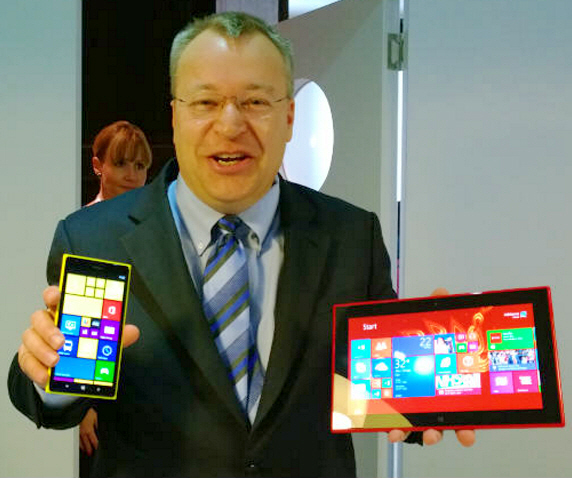
Elop shows off Nokia's latest large screen Lumia smartphone and the new Lumia tablet.
There is certainly precedent for doing so and there is certainly cause to believe that being spun out may in fact help both groups to maximize their efforts. Does anyone remember that Expedia was once an internal Microsoft project before it was spun out? Bing and Xbox can easily go in the same direction. If Elop were Microsoft's CEO these two groups and what to do with them would be at the top of his to-do list. There is no guarantee of course that any spinoffs would actually take place but it makes sense for Elop to position his strategies in these directions at this point in time.
The Hallowed Halls of Office
There is more to Elop's plans than that however. Perhaps even more importantly, Elop would strongly consider a shift for Microsoft on a much grander scale that involves one of the sacred groups within Microsoft - Office. Elop certainly knows Office. Before he left to put his stamp on Nokia his last assignment at Microsoft was heading up the Office teams and its products. He was in charge when Office 365 - the Web-based subscription version of Office was developed and launched.
Elop has always been a Microsoft kind of guy.
What would Elop do here? For the most part he would make it a "full speed ahead" effort to make the entire Office suite available on every possible smartphone and tablet on the planet, including of course all iOS devices. At one point we ourselves thought that Microsoft should leverage Office strictly for its own Windows Phone 7 and 8 efforts - but even though WP8 is making excellent inroads from a market percentages perspective (360 percent growth sounds great) total market share is still miniscule (5 percent total market share doesn't sound as good as 360 percent growth) and keeping Office for its own use is simply not a viable strategy.
In other words, Elop might conceivably unbundle Office from being a pure Windows-centricplatform and would no longer seek to use that vast Office popularity to underpin ongoing Windows-only operating system and hardware support. It would become a far more ubiquitous Office, and it is a strategy that Microsoft now needs to adopt. Greatly expanding Office sales is a better option at this point than continuing to use it to sell copies of Windows.
It is not a strategy that Steve Ballmer would ever be able to support. Given that Elop was smart enough to realize he needed to jettison Symbian from Nokia, he certainly has demonstrated an ability to step outside of the well-worn box. But Office is an entirely different beast in terms of size and massive revenue so the difficulty of doing so would be greatly amped up from letting go of Symbian at Nokia. Still, it gives Elop a real edge of sorts. How Office and Office 365 are handled will be quite significant to Microsoft's future success.
Finally, and again as it relates directly to both Office and Microsoft's new "devices and services" mantra, Elop demonstrated solid foresight in taking Nokia’s excellent mapping and location-tracking software and quickly evolved it into a standalone software business called Here. Here could have been packaged exclusively for a Nokia-only ecosystem, but rather than use it to provide a differentiator for Nokia’s own smartphones and the Windows Phone OS (as Office now is used for Windows), he took the major step of extending Here as a business across all potential platforms. It is where exactly where Office needs to go.
As we noted earlier it is surely convenient for those people who spoke to Bloomberg - and who asked not to be identified because Elop hasn’t actually finalized or publicly discussed his analysis of the business - to let us know his thinking. Aside from Xbox and Kinect, which we absolutely believe needs to remain within Microsoft, we like what Elop's apparent acolytes have to share about his thinking. For the most part it fits exactly within where Microsoft must go.
Edited by
Cassandra Tucker
