In case you haven't heard, back on November 7th, the United States Patent and Trademark Office (USPTO) announced that Motorola Mobility had filed a patent application back in May 2012 titled "Coupling an Electronic Skin Tattoo to a Mobile Communication Device." Hmm – a tattoo, meaning some sort of electronic device that can be superficially attached to one's skin giving the appearance of a tattoo. We should note that calling such a thing a tattoo is strictly convenient – it isn't really a tattoo. Nokia and MC10, among others, have also been working on electronic devices that are similar in nature.
In this particular case the idea is to create a communications device. Here is the abstract from the patent application itself:
A system and method provides auxiliary voice input to a mobile communication device (MCD). The system comprises an electronic skin tattoo capable of being applied to a throat region of a body. The electronic skin tattoo can include an embedded microphone; a transceiver for enabling wireless communication with the MCD; and a power supply configured to receive energizing signals from a personal area network associated with the MCD. A controller is communicatively coupled to the power supply. The controller can be configured to receive a signal from the MCD to initiate reception of an audio stream picked up from the throat region of the body for subsequent audio detection by the MCD under an improved signal-to-noise ratio than without the employment of the electronic skin tattoo.
As patent abstracts go, this one is actually admirably clear in its intentions. Essentially we're talking about a microphone that is capable of picking up an audio stream (right, your voice) and increasing the clarity of that voice stream (improved signal to noise ration).
It is interesting. Here is Act 1: The first thing one thinks of course is Google Glass. Maybe there is a next step in the overall Google Glass package that will provide an option for enhanced voice recognition. Perhaps there are interesting applications Google and Motorola have in mind that might require enhanced audio for use with Glass apps. Who knows what they are for – perhaps it is an NSA request!
Here is Act 2: Perhaps such a device might work with a Motorola smartwatch so that one might be able to speak to a smartphone through a smartwatch but without the need to speak all that loudly. Quite honestly, this is probably what we are looking at here. The tattoo is not meant to be permanent – it is meant to be applied more or less like a piece of tape and can be easily removed by the user.
The patent application does suggest that there might be security applications that can make use of such a device – again, keep in mind that we are speaking here about voice enhancement. Perhaps the tattoo is meant to communicate not with a smartphone, but with a powerful transmitter that someone might have in a pocket. Secret agents, the FBI, SWAT teams… or perhaps just a retail employee walking around a store and reporting back to a stockroom on what shelves need to be restocked. From the nefarious to the mundane – the possibilities are endless.
Now we arrive at Act 3, and for this let's turn back to the patent application itself again:
Optionally, the electronic skin tattoo 200 can further include a galvanic skin response detector to detect skin resistance of a user. It is contemplated that a user that may be nervous or engaging in speaking falsehoods may exhibit different galvanic skin response than a more confident, truth telling individual.
The "200" in the above refers to the following diagram, where the tattoo itself is listed as "200" where the person depicted has the tattoo in place:
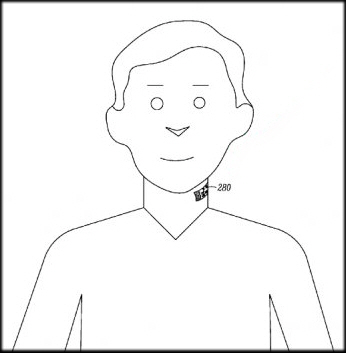
In any case, what the above describes is essentially some sort of enhanced lie detector! We'll leave it to your imagination how such a device might be used. It may conceivably be put to use under friendly fire so to speak - perhaps it can be used with an agent someone doesn't trust to ensure they are not lying while out in the field. Perhaps a drug lord will want one to ensure his field workers aren't cheating on him. In any case, the lie detector use is clearly noted in the patent application so perhaps some company actually requested that Motorola work on such a device.
There is certainly no thanks that need to be offered for Act 3. But really, we suspect it is Act 2 that will provide all the real action in this story. We'll see how it pans out over time.
Edited by
Erik Linask